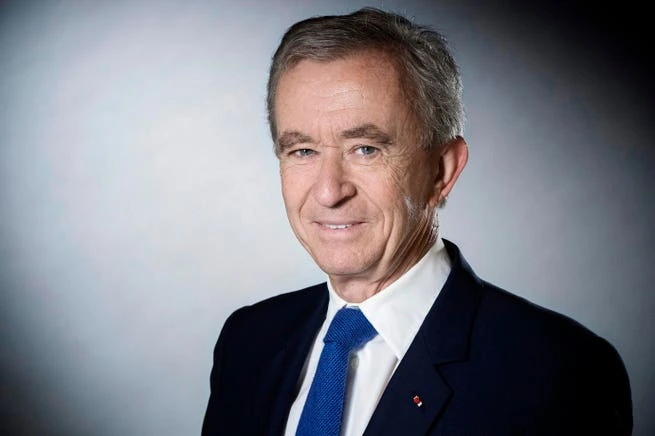
Neither figure is 'wrong.' They are both estimates, and both are built primarily on the value of the Arnault family's stake in LVMH, the world's largest luxury goods group. The short version: Arnault is worth roughly $170 to $200 billion in early 2026, and that fortune lives or dies with LVMH's share price.
How these net worth estimates are actually calculated
Understanding the number means understanding where it comes from. Arnault does not have $170+ billion sitting in a bank account. The vast majority of his estimated wealth is tied to his family's controlling stake in LVMH Moët Hennessy Louis Vuitton, the conglomerate that owns Louis Vuitton, Dior, Bulgari, Tiffany & Co., Moët & Chandon, and dozens of other luxury brands.
The Arnault family group holds roughly 50% of LVMH's share capital and around 65-66% of its voting rights, with the exact percentages shifting slightly as transactions occur. An AMF (French financial regulator) notification from February 2026 confirmed the family group held 50.01% of LVMH share capital and 65.94% of voting rights. LVMH's own 2024 annual report showed the family group at approximately 49% of capital and 64.8% of voting rights. The difference between those figures reflects real-time stake changes through share purchases.
To turn a stake percentage into a net worth figure, trackers multiply the family's percentage ownership by LVMH's total market capitalization. If LVMH's market cap is, say, $350 billion and the family controls roughly 50%, the stake is worth about $175 billion. Add other assets, subtract known liabilities, and you get the headline number. The challenge is that the Arnault family holds this stake through a layered structure of holding companies, including Financière Agache and Christian Dior SE, whose internal ownership is not always fully transparent. Bloomberg explicitly acknowledges this in its methodology, noting that complex structures require 'calculated assumptions' of ownership.
Forbes' annual list locks in a single snapshot date (March 1 for the 2026 list) and holds that figure for the year's publication. Its real-time tracker updates public stock holdings every five minutes while markets are open. Bloomberg refreshes its Billionaires Index every day based on closing prices. That is why you will often see three or four different numbers floating around for the same person at the same time.
Bernard Arnault's net worth in billions and his global ranking

| Source | Estimated Net Worth (USD) | World Rank | As of Date |
|---|
| Forbes 2026 Billionaires List | $171 billion | #7 | March 1, 2026 |
| Bloomberg Billionaires Index | $202 billion | #7 | Daily (recent close) |
| Forbes Real-Time (late 2024 snapshot) | $171.3 billion | #5 | Mid-December 2024 |
| Bloomberg (mid-2024 peak period) | $231 billion | Top 3 | Late March 2024 |
The ranking fluctuates constantly alongside LVMH's share price and movements among the world's other mega-billionaires (Elon Musk, Jeff Bezos, Mark Zuckerberg). At his peak in early 2024, Arnault briefly held the #1 spot globally. By early 2026, he had settled at #7 on both Forbes and Bloomberg. That drop in rank is not primarily because his wealth shrank dramatically in absolute terms; it is partly because other fortunes grew faster, and partly because LVMH shares pulled back significantly from their 2023-2024 highs.
How his fortune has changed over time
Arnault's wealth trajectory over the past decade is essentially a chart of LVMH's stock price. The brand built steadily through the 2010s as LVMH expanded its portfolio and luxury demand grew globally, particularly in China. By the early 2020s, post-pandemic luxury spending sent LVMH shares (and Arnault's paper wealth) into extraordinary territory.
The peak came in early 2024. Bloomberg estimated his fortune at $231 billion in late March 2024, which put him briefly among the world's richest individuals and, at times, at the very top of global rankings. Then LVMH shares, which had peaked in early 2024, began falling steadily from April onward. Fortune, citing Bloomberg data, reported that the roughly 20% drop in LVMH stock translated into a $54 billion reduction in Arnault's net worth. Forbes separately tracked the damage at nearly $25 billion wiped away over that same period, representing a 12.6% hit to his fortune.
By mid-December 2024, Forbes' real-time tracker had him at $171.3 billion, placing him at #5 globally. By the Forbes annual snapshot in March 2026, the figure was $171 billion with a #7 rank. Forbes Australia lists “7. Bernard Arnault” with an estimated net worth of $171 billion and places it in the context of his control of LVMH Forbes' annual snapshot in March 2026, the figure was $171 billion with a #7 rank. The headline takeaway: his fortune roughly halved its peak gains and settled back to where it was before the big 2023-2024 luxury boom.
A timeline of the big numbers
Here is a rough timeline of key data points that show how Arnault's fortune has moved. Think of this as a simplified chart in list form. The numbers come from Forbes, Bloomberg, and contemporaneous reporting.
| Period | Estimated Net Worth | Key Event or Driver |
|---|
| Late 2021 | ~$150–160 billion | LVMH share price rising; post-pandemic luxury rebound begins |
| Late March 2024 | ~$231 billion (Bloomberg) | LVMH at or near all-time high; Arnault briefly near #1 globally |
| Mid-2024 | ~$177–192 billion | LVMH shares drop ~20%; ~$54B wiped from estimated fortune |
| Mid-December 2024 | $171.3 billion (Forbes real-time) | Ranked #5 on Forbes real-time list |
| March 1, 2026 | $171 billion (Forbes annual) | Ranked #7 on Forbes 2026 World's Billionaires list |
| Early 2026 (Bloomberg) | $202 billion (Bloomberg Index) | Daily Bloomberg figure; higher due to different methodology and date |
The gap between the $171B Forbes number and the $202B Bloomberg number in early 2026 is a good illustration of why you should always note which tracker you are reading and what date the figure is tied to. Bloomberg's daily methodology and Forbes' March 1 snapshot can diverge by tens of billions depending on where LVMH shares traded on any given day.
How to read net worth charts and graphs for Arnault

If you pull up Bloomberg's Billionaires Index profile for Arnault, you will see a wealth chart that shows his fortune changing over time, with each data point reflecting the estimated value of his stake based on that day's closing LVMH share price plus other identified assets. The line moves up and down in direct correlation with LVMH stock, with occasional jumps when dividends are paid, stakes are restructured, or major acquisitions change LVMH's market cap.
What looks like a dramatic 'crash' on those charts is usually not Arnault selling assets or losing a business. It is LVMH's share price falling. And what looks like explosive growth in 2021-2023 was largely the global luxury boom driving LVMH's market cap to record levels. The practical lesson: treat any single net worth number as a snapshot tied to a specific day, not a fixed fact.
Forbes also provides a historical chart on its real-time billionaires page, which shows year-over-year trends. Because it updates every five minutes during market hours, it is useful for tracking short-term movements, while the annual list gives you the most directly comparable year-to-year data point.
Bernard Arnault vs the Arnault family: who owns what?
This is where things get genuinely confusing for most readers. Forbes explicitly labels its figure 'Bernard Arnault & family,' which signals that the estimate covers wealth held through family-controlled structures, not a purely individual fortune. Bloomberg presents its figure as Arnault's 'personal wealth,' but its own methodology notes that family holding structures require calculated assumptions. In practice, the two figures are measuring largely the same pool of assets: the Arnault family's collective controlling stake in LVMH, held through entities like Financière Agache, Christian Dior SE, and related holding companies.
Bernard Arnault himself controls these structures, so the net worth figures are typically treated as his even though the legal ownership is spread across a family group. The actual split between Bernard personally and his family members is not publicly disclosed in a way that allows a precise individual-versus-family breakdown. When you see the $171B or $202B figures, treat them as the value of the empire Bernard controls, with the understanding that portions flow through family-held entities.
His sons' net worth

Bernard Arnault has five children, four of whom hold significant roles within the LVMH group. His sons Antoine, Alexandre, Frédéric, and Jean all hold executive positions across the empire's brands, and his daughter Delphine leads Christian Dior Couture. Their individual net worths are not tracked with the same precision as their father's, since their personal stakes are harder to isolate from the broader family holding structure.
Frédéric Arnault, who runs TAG Heuer and has taken on broader digital strategy roles, has an estimated net worth tied to his position in the family hierarchy and any personal allocations from the broader structure. You can read more about his specific estimated fortune in this profile of Frédéric Arnault's net worth. To see how that estimate is put together, check Frédéric Arnault's net worth breakdown and latest figures. Similarly, Jean Arnault, who oversees watches at Louis Vuitton, is building his profile within the group, and his estimated wealth is covered in the Jean Arnault net worth breakdown.
The key point is that the sons' individual net worths are fractions of the headline family figure. The $171-202 billion estimate belongs to Bernard's controlling position; his children's personal fortunes, while substantial by any measure, are not included in that headline number in a way that doubles or significantly inflates it.
The companies that drive the number
LVMH is the engine. It is the world's largest luxury conglomerate, with over 75 brands across fashion, leather goods, wines and spirits, perfumes, cosmetics, watches, jewelry, and selective retailing. Louis Vuitton and Dior are the biggest profit drivers. When those brands perform well in China, the US, and Europe, LVMH's revenue and profit grow, the share price rises, and Arnault's estimated net worth goes up. When demand softens, particularly in China as happened through 2024, the reverse occurs.
The holding structure matters here. The Arnault family does not just own LVMH shares directly. The chain runs roughly: Bernard Arnault and family members control Financière Agache, which controls Christian Dior SE (which itself owns a direct stake in LVMH), and through that chain the family exercises majority capital and voting control over LVMH. This is why the Financière Agache prospectus from late 2021 could show 47.3% of LVMH capital and 63.2% voting rights, while more recent filings show higher percentages as the family has continued accumulating shares.
Beyond LVMH, Arnault has personal investments and assets, including real estate. He is known to own properties in Paris and internationally, and there have been reports of a superyacht and other high-value personal assets. These are included in trackers' estimates where they can be identified, but they represent a small fraction of the total figure. The $171-202 billion is overwhelmingly an LVMH story. If you want to understand how Louis Vuitton ties into Arnault's net worth, the core answer is that Louis Vuitton as a brand is LVMH's single largest profit contributor, which is why its performance matters so directly to the headline fortune figure.
Why Forbes and Bloomberg often show different numbers
This is worth a direct explanation because the gap can be jarring. Forbes and Bloomberg use different snapshot dates, different methodologies for handling complex holding structures, and in some cases different assumptions about which assets to include or how to value non-public holdings. Forbes' annual list locks in March 1 figures each year, while Bloomberg refreshes daily. On any given day, LVMH's share price could move the Bloomberg figure by several billion dollars in either direction.
Both trackers also acknowledge that for someone like Arnault, whose wealth is embedded in a multi-layered family holding company structure, there is inherent imprecision. Bloomberg's methodology explicitly notes that indirect control through holding companies may require calculated assumptions, and that individuals or their representatives can provide feedback on the calculation. This is not a criticism of either tracker; it is just the honest reality of estimating a fortune that is mostly locked up in controlling stakes rather than liquid cash.
For practical purposes: if you want the most current estimate, check Bloomberg's Billionaires Index for today's closing-price figure. If you want a widely cited annual benchmark, use Forbes' annual list figure. If you see a number from a news article, check when it was published and which source it cited, because a figure from six months ago could be off by $30-50 billion given how much LVMH's share price has moved.
How to track Arnault's net worth going forward
- Bookmark Bloomberg's Billionaires Index profile for Arnault: it updates daily and shows both the current figure and a change indicator, so you can see the direction of movement at a glance.
- Check Forbes' real-time billionaires tracker for a five-minute-delayed figure during market hours; note the date and that Forbes uses 'Bernard Arnault & family' as the label.
- Watch LVMH's share price on the Paris Bourse (ticker: MC.PA) as a proxy; if LVMH shares rise or fall significantly, Arnault's estimated net worth moves proportionally given the family's ~50% stake.
- For the definitive annual snapshot, Forbes' March release is the most widely cited and allows apples-to-apples year-over-year comparison.
- For ownership structure updates, the French financial regulator AMF publishes threshold-crossing notifications whenever the Arnault family group buys or sells enough shares to cross a 1% ownership level, which is how the February 2026 50.01% figure became public.