Quick answer: Jean-Claude Duvalier's net worth today
Jean-Claude "Baby Doc" Duvalier does not have a clean, verified net worth figure the way a CEO or celebrity might. What we can say with confidence is this: estimates of the wealth he controlled or accumulated during his 15-year presidency (1971–1986) have ranged from tens of millions to several hundred million US dollars, depending on the source and the methodology. The most credible and documented portion of that wealth, the funds frozen in Swiss banks, came to roughly CHF 6 to 7 million (approximately USD $6–7 million) at the time of confiscation proceedings. That is a far cry from the $900 million figure Haiti alleged in 1986, but it represents only what investigators could trace and freeze in one jurisdiction. Human Rights Watch’s October 1986 report on “Duvalierism” discusses Haitian allegations, including an estimate of $800 million, and describes legal action involving Duvalier assets in Switzerland blank" rel="noopener noreferrer">$900 million. Jean-Claude Duvalier died in October 2014 in Port-au-Prince, so any discussion of his "net worth today" really means: what remained of his estate, what was recovered by Haiti, and what, if anything, was never found.
The most defensible range for wealth Jean-Claude personally controlled or benefited from during his presidency sits somewhere between $300 million and $800 million in inflation-adjusted terms, based on the scale of the alleged embezzlement and the documented outflows from Haitian state accounts. By the time of his death, his personal accessible assets were almost certainly a small fraction of that, reduced by decades of legal battles, lifestyle spending during his Paris exile, and asset recovery actions. If you are looking for a single number to anchor on, treat anything under $50 million as a reasonable estimate of what he personally retained by his final years.
What about François Duvalier's net worth? (and why people mix the two up)
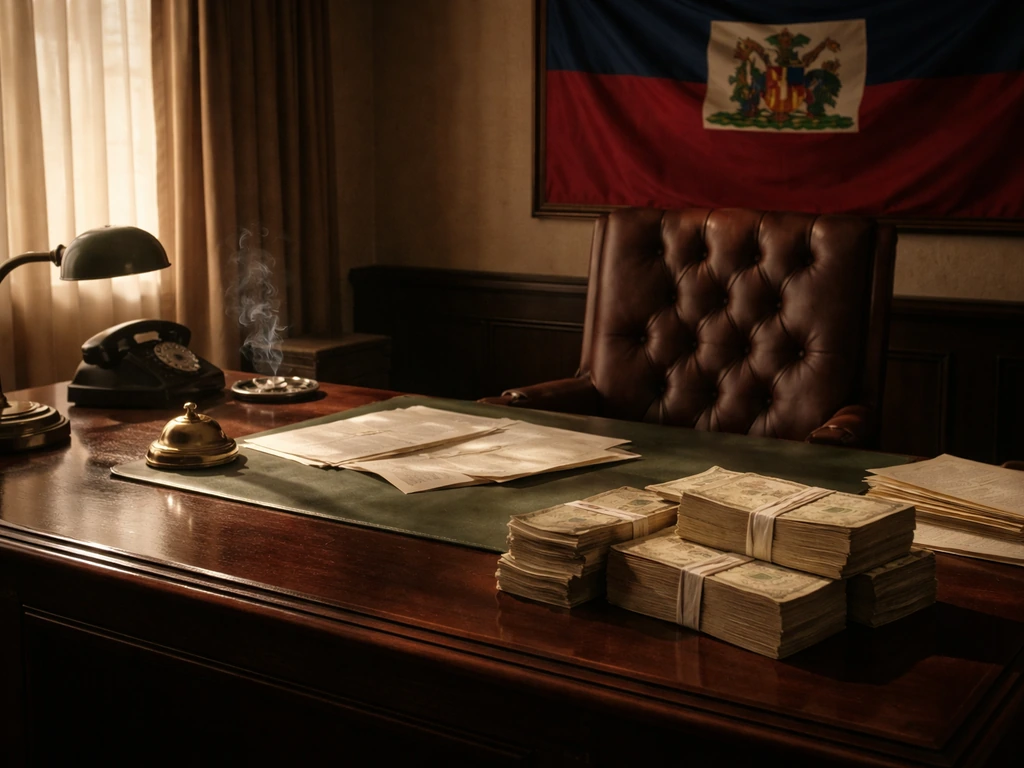
François "Papa Doc" Duvalier ruled Haiti from 1957 until his death in 1971. He is Jean-Claude's father, and the two are frequently confused in searches, partly because their names are similar and partly because their regimes were one continuous 29-year stretch of Duvalier family rule. Searches for "francois duvalier net worth" or "jean-claude duvalier net worth" often surface the same articles because the family's wealth was treated as a single dynasty pool.
François Duvalier's personal accumulated wealth is even harder to document than his son's. He died in office, so there was no exile, no Swiss freeze request, and no formal international asset recovery process directed specifically at Papa Doc's holdings. He ruled during an era when Haitian state finances were barely transparent, foreign aid flowed in from the US (partly as Cold War patronage), and domestic accounts were not audited by outside bodies. Estimates of what François personally extracted from the Haitian treasury are largely speculative, but historians and economists who study kleptocracy generally place the Duvalier dynasty's total extraction across both regimes in the range of $500 million to $1 billion over 29 years, in contemporary dollars. François's personal share of that is impossible to isolate with precision.
The practical takeaway: if you searched for either man's net worth, you are really asking the same underlying question about a single dynastic fortune built through state capture. The Swiss asset freeze and subsequent legal actions all refer to Jean-Claude's era, since he was the one who fled and left a recoverable paper trail.
Where the money came from: power, state access, and asset channels
Neither Duvalier built wealth through a business, a brand, or an investment portfolio in any conventional sense. Their fortunes were state-linked from the start, built through direct control of Haiti's public finances and extraction mechanisms. Understanding the source is essential for understanding why the numbers are so uncertain.
François Duvalier's revenue streams

- Direct diversion of US foreign aid and IMF disbursements during the Cold War period
- Control of the Tonton Macoutes, his paramilitary force, which ran extortion and protection rackets
- Forced "contributions" from Haitian businesses and foreign companies operating in Haiti
- Manipulation of state enterprises and customs revenues
- Personal control of the national lottery and tobacco monopoly revenues
Jean-Claude Duvalier's documented and alleged channels
- Continuation and expansion of his father's extraction model through the 1970s and early 1980s
- Direct transfers from the Haitian Central Bank to personal accounts, which Haiti alleged amounted to up to $900 million in total embezzlement
- Funds held in Swiss bank accounts, confirmed frozen at approximately CHF 6–7 million (roughly USD $6–7 million) in Geneva institutions
- Real estate and assets in France, held during his Paris exile from 1986 onward
- Luxury goods, vehicles, and property reportedly sold or dissipated during the exile years
- Associates and cabinet members who held related funds, including the CHF 4.5 million (roughly USD $4.55 million) blocked in a Geneva account tied to a former Haitian cabinet minister in his circle
The gap between the $900 million Haiti alleged and the $6–7 million Switzerland eventually traced is not necessarily fraud in the accounting, it reflects how kleptocratic wealth works. Much of it was spent, moved through shell structures that are no longer traceable, converted to physical assets that cannot be frozen, or held in jurisdictions that did not cooperate with recovery efforts. Swiss banks were famously opaque until international pressure forced cooperation in the 1990s and 2000s.
For a conventional public figure, net worth is calculated from disclosed assets: company shares, real estate filings, salary records, and public statements. For a former dictator, the methodology is completely different, and the results are far less reliable. For comparison, you may also see claims about the French president net worth, but public figures there also rely heavily on estimates rather than fully transparent totals.
- Court and legal filings: Asset freeze orders, confiscation rulings, and forfeiture judgments are the most concrete data points. The Swiss Federal Administrative Court's rulings on the Duvalier accounts are the gold standard here because they cite specific CHF amounts.
- Investigative journalism and NGO reporting: Organizations like Global Financial Integrity and the World Bank's Stolen Asset Recovery Initiative (StAR) publish estimates based on tracing capital flows and comparing them to official Haitian budget records.
- Government allegations vs. proven amounts: Haiti's 1986 claim of $900 million embezzled was an allegation, not a court-verified figure. Always distinguish what was claimed from what was documented.
- Inflation and currency adjustment: Dollar figures from 1986 need to be adjusted. The CHF 6 million frozen in 1986 would be worth roughly CHF 9–10 million in 2026 terms, adjusting for Swiss inflation.
- Lifestyle and spending reconstruction: Researchers sometimes work backward from known expenditures (Paris apartments, luxury purchases, legal fees) to estimate what total assets must have been.
- Estate and probate records: For Jean-Claude, who died in 2014, Haitian estate records might theoretically document remaining assets, but Haiti's administrative records are not consistently accessible to outside researchers.
The reason different sources report wildly different numbers is that they are often measuring different things. A journalist citing $900 million is repeating Haiti's 1986 allegation. In an r/haiti discussion about Duvalier-linked wealth claims, a user repeated a “900 million dollars” figure associated with “Baby doc,” reflecting audience perception rather than documented evidence a user repeated a “900 million dollars” figure associated with “Baby doc”. A legal database citing $5.7 million is reporting what the Swiss Supreme Court ordered transferred. Both figures are technically accurate in their own context. Neither one alone tells the full story.
The Swiss asset saga: what happened over time

The most documented chapter of the Duvalier wealth story played out in Switzerland over three decades, and it is worth walking through because it shows exactly how these numbers changed and why.
| Year / Period | Development | Amount Referenced |
|---|
| 1986 | Haiti requests Switzerland confiscate Duvalier funds; Switzerland freezes accounts | Up to $900M alleged; ~$397M alleged in Swiss accounts |
| 1986 onward | Swiss Federal Department of Foreign Affairs confirms accounts remain blocked pending legal review | CHF ~6 million frozen in Geneva accounts |
| 2010 | Swiss Federal Supreme Court orders release of USD $5.7 million to the Duvalier family (pending further proceedings) | USD $5.7 million |
| 2010s | Federal Criminal Court in Bellinzona rejects Duvalier family appeal; backs return of funds to Haiti | Approx. CHF 7 million (~USD $6.55 million) |
| Post-2010 | Swiss Federal Administrative Court upholds confiscation action; amount confirmed as more than CHF 4 million | More than CHF 4 million |
| Ongoing | CHF 4.5 million in Geneva account tied to former Haitian cabinet minister in Duvalier circle blocked separately | CHF 4.5 million (~USD $4.55 million) |
The numbers in that table overlap because different courts and agencies were acting on different account clusters at different times. The CHF 6 million figure and the CHF 7 million figure likely refer to the same core pool with interest and legal fees accrued. The $5.7 million USD figure reflects a specific court order at a specific exchange rate. What the table shows clearly is that the recoverable, documented Swiss portion of the Duvalier fortune was in the single-digit millions of dollars, not hundreds of millions.
Jean-Claude returned to Haiti in 2011 after 25 years in exile and faced renewed calls for prosecution on corruption and human rights charges. He died in October 2014 before any criminal conviction was secured. His death effectively ended the Swiss proceedings tied directly to him personally, though related accounts connected to associates continued through separate legal channels.
It is also worth noting that other Haitian political figures have faced similar wealth scrutiny. Profiles of Jean-Bertrand Aristide often include disputed net worth figures, with international scrutiny and hard-to-verify totals Jean-Bertrand Aristide net worth. Profiles of figures like Jean-Bertrand Aristide, Jovenel Moïse, and others connected to Haitian political life follow a similar pattern of disputed estimates, international asset tracking, and difficult-to-verify totals. If you’re comparing Duvalier-era claims to more recent cases, Jovenel Moïse net worth estimates are often similarly disputed and based on uneven documentation.
How to verify claims and read conflicting numbers
If you are trying to make sense of what you read about the Duvalier net worth today, here is a practical checklist for evaluating any source you find. These kinds of uncertainties also explain why searches for Eric Jean Baptiste Haiti net worth tend to bring up competing claims and partial documentation.
- Check whether the number is an allegation or a court finding. Haiti's $900 million claim was a formal request to Switzerland, not a verified forensic audit result. If a source does not distinguish between the two, treat the figure as a rough estimate at best.
- Look for the jurisdiction and date. Swiss court rulings from the 2000s and 2010s are the most reliable documented data points. Anything from 1986 is an early estimate made under political pressure.
- Adjust for exchange rates and inflation. CHF figures from 1986 are not equivalent to today's USD. Use a currency converter and an inflation calculator to put numbers in comparable terms.
- Identify what is included. Some estimates cover only Jean-Claude. Others aggregate the entire Duvalier dynasty. Some include assets held by associates and family members, not just the man himself.
- Check the World Bank StAR database and FDFA press releases directly. These are primary sources with specific figures and dates, and they are freely accessible online.
- Be skeptical of round numbers. Figures like $900 million or $500 million are almost always political estimates or journalistic shorthand, not forensic calculations.
- Cross-reference with investigative outlets. Reporters at Reuters, AP, and swissinfo.ch covered the Swiss proceedings in detail. Their archived reporting gives you the most granular breakdown of what was frozen, contested, and eventually transferred.
The honest bottom line is that you will not find a single verified figure for Jean-Claude Duvalier's net worth, and anyone who gives you one without caveats is oversimplifying. This same approach helps explain why estimates for Olivier Martelly net worth are often disputed and hard to verify. The Swiss proceedings documented roughly $6–7 million in traceable, frozen assets. The World Bank/StAR announcement states it welcomed the Swiss handover of “US$6 million” of assets “allegedly plundered by former Haitian President Jean-Claude Duvalier and associates” to Haiti on February 13, 2009 blank" rel="noopener noreferrer">Swiss proceedings documented roughly $6–7 million in traceable, frozen assets.. The total wealth extracted from Haiti across both Duvalier regimes is plausibly in the hundreds of millions. What Jean-Claude personally held at the time of his death was somewhere in between, probably in the low tens of millions at most, reduced significantly from its peak. For a wealth-curious reader, that gap between the headline claim and the documented reality is itself the most interesting part of the story. For more on how these disputed figures translate into an overall Laurent Saint-Cyr Haiti net worth narrative, see our dedicated breakdown. Laurent Gbagbo net worth is often discussed in the same way, with widely varying claims that depend on what assets can be traced and verified.