
Olivier Baussan's net worth is estimated at approximately €150–200 million as of mid-2026, based on the diluted but still meaningful stake he retained in L'Occitane International S.A. at the time of the company's October 2024 take-private, supplemented by his other Provençal business interests. His vehicle, Olivier Baussan S.à r.l., held roughly 4.2% of L'Occitane's share capital at the time of the 2010 Hong Kong IPO. Applying the HK$34.00 per share offer price announced on 29 April 2024 to that approximate stake level, and adjusting for subsequent dilution and partial sales over 14 years of public trading, produces a gross pre-tax range in that ballpark. This is a moderate-confidence estimate: the post-IPO stake trajectory is not fully public, and no personal wealth disclosure by Baussan himself exists.
Olivier Baussan Net Worth: 2026 Estimate, Sources & Breakdown

Quick snapshot
| Item | Detail | Confidence / Source |
|---|---|---|
| Estimated net worth | €150–200 million | Moderate — calculated from disclosed IPO stake and 2024 offer price; post-IPO dilution assumed |
| Estimate date | August 2026 (based on October 2024 transaction close) | High — transaction close confirmed by company press release, 15 October 2024 |
| Primary wealth driver | Founding stake in L'Occitane en Provence (HKEx: 973, now private) | High — prospectus (April 2010, HKEX filing) and 2024 offer announcement |
| IPO stake (Olivier Baussan S.à r.l.) | ~4.2% of share capital as at 31 March 2010 | High — Web Proof Information Pack, HKEX filing (April–May 2010) |
| Take-private offer price | HK$34.00 per share | High — company press release, 29 April 2024 |
| Implied company valuation at privatisation | ~US$6.4–7.0 billion (including debt) | High — Bloomberg, 29 April 2024; company announcement |
| Secondary interests | Oliviers & Co, Première Pression Provence, Maison Brémond (Confiserie Brémond Fils) | Moderate — Wikipedia, regional press, tourism listings |
| Forbes / Bloomberg wealth list appearance | Not ranked (below billionaire threshold) | High — no appearance on published lists |
Why Baussan matters in the French luxury landscape
Olivier Baussan is not a billionaire on the scale of Bernard Arnault or François-Henri Pinault, but he is one of the rare French entrepreneurs who built a globally recognised luxury beauty brand from scratch in rural Provence and took it to a major stock exchange. He founded L'Occitane en Provence in 1976 when he was 23 years old, grew it into a business generating more than €537 million in annual revenue by fiscal year 2009, and presided over a Hong Kong IPO in 2010 that raised approximately US$708 million. His fortune is modest by LVMH standards but impressive for an independent founder who started by distilling lavender oil with a portable still. The 2024 privatisation of L'Occitane at a roughly US$6.4–7.0 billion enterprise value was the final major liquidity event tied to his original creation.
The man behind the lavender fields: biography
Early life and education
Olivier Baussan was born in 1953 in France. He grew up with a strong connection to Provence and its agricultural traditions, an upbringing that would directly shape his entrepreneurial instincts. He studied at the University of Aix-Marseille, where he developed an interest in natural ingredients and regional heritage. No advanced business school degree is publicly documented; his education was largely practical and rooted in the Provençal landscape he would later commercialise.
Career milestones
- 1976: Founded L'Occitane en Provence in Manosque, Haute-Provence, initially producing rosemary essential oil using a portable still purchased for roughly 3,000 French francs.
- Late 1970s–1980s: Expanded the product range to include shea butter, lavender, and other Provençal botanicals; opened the first retail boutique in Volx.
- Mid-1990s: Sold a controlling interest to Austrian entrepreneur Reinold Geiger, who became the long-term majority shareholder and chief executive.
- 1990s–2000s: Baussan remained a creative consultant and brand guardian; he also founded Oliviers & Co, a retail brand dedicated to premium olive oils from the Mediterranean basin.
- 2006: The L'Occitane Foundation was established, with Baussan credited in prospectus materials as involved in its founding mission.
- 2007: A leveraged management buyout restructured the holding company (LOG) as sole direct shareholder of the operating group.
- 2008: Baussan resigned as a director of L'Occitane International S.A. (30 September 2008, per prospectus disclosure) but continued as a creative consultant.
- 2010: L'Occitane International S.A. listed on the Hong Kong Stock Exchange (HKEx: 973); Baussan's vehicle held ~4.2% at IPO.
- c. 2015: Acquired Confiserie Brémond Fils (Maison Brémond) in Aix-en-Provence, a historic Provençal food brand, per regional press.
- 2024: L'Occitane taken private at HK$34.00 per share; transaction closed 15 October 2024.
How L'Occitane built his fortune
L'Occitane en Provence is the engine of Baussan's wealth. He founded the company in 1976 with minimal capital, distilling rosemary oil by hand in Manosque. The brand's identity, rooted in authentic Provençal ingredients and artisanal aesthetics, proved commercially durable across global markets. By the time of the 2010 IPO, the company operated hundreds of stores worldwide and reported annual revenues exceeding €537 million for fiscal year ending March 2009.
The key financial event for Baussan personally was the Hong Kong IPO on 7 May 2010. The offering comprised 364,120,000 shares (182,060,000 new shares and 182,060,000 existing shares sold), priced at a maximum of HK$15.08 per share, raising approximately US$708 million. L'Occitane raises $708 million in Hong Kong IPO, FinanceAsia, 3 May 2010 L'Occitane raises $708 million in Hong Kong IPO — FinanceAsia, 3 May 2010. At this point, his vehicle Olivier Baussan S.à r.l. held roughly 4.2% of the enlarged share capital, giving him a gross paper value of approximately US$29–30 million at IPO price on his direct stake alone, though his broader economic interest through the LOG shareholder group was larger. The IPO gave him his first clean, liquid benchmark for the value of what he had created.
Revenue growth after the IPO was substantial. L'Occitane expanded aggressively in Asia, the Americas, and the Middle East, building the brand equity that ultimately justified the HK$34.00 per share privatisation offer in 2024. That offer price implied a company market capitalisation and enterprise value of roughly US$6.4–7.0 billion, more than double the IPO-era valuation on a per-share basis.
Ownership, the IPO, and the 2024 take-private
Baussan's ownership journey is a classic founder-dilution story. He started with 100% ownership, sold a controlling interest to Reinold Geiger in the mid-1990s, saw further dilution through the 2007 leveraged management buyout that created the LOG holding structure, and then experienced the standard IPO dilution when 25% of the enlarged share capital was sold to public investors. By March 2010 his vehicle's position stood at approximately 4.2% of share capital as disclosed in the HKEX prospectus appendix.
After the IPO, Baussan's precise shareholding movements are not fully documented in public filings, since minority shareholders below certain disclosure thresholds are not required to file updates on the Hong Kong exchange. It is reasonable to assume some ongoing dilution from employee share schemes and possible partial sales, which is why the net worth estimate presented here uses a conservative range rather than a single figure.
On 29 April 2024, Reinold Geiger's controlling shareholder vehicles announced a cash offer to take L'Occitane private at HK$34.00 per share. The transaction was backed by Goldman Sachs Alternatives and Blackstone Tactical Opportunities, who announced financing commitments of up to €1.551 billion on 30 July 2024. The transaction closed on 15 October 2024, ending 14 years of public trading. At the offer price of HK$34.00, any remaining stake held by Baussan's vehicle would have been cashed out, representing his largest single liquidity event since the original sale to Geiger in the 1990s.
Beyond L'Occitane: other businesses and investments
Baussan channelled his passion for Provence into several ventures outside L'Occitane. The most prominent is Oliviers & Co, a retail and e-commerce brand dedicated to premium olive oils sourced from producers across the Mediterranean. The brand operates boutiques in France, the United States, and other markets, positioning itself in the fine food niche adjacent to luxury beauty. No public valuation of Oliviers & Co exists, but it is a functioning retail business with a recognisable brand identity.
He also founded Première Pression Provence, a smaller artisanal olive oil project focused on single-estate, cold-pressed production from Provençal growers. This sits closer to the craft end of the spectrum than Oliviers & Co and is unlikely to represent material wealth on its own, but it reinforces Baussan's identity as a serial Provençal food and beauty entrepreneur.
Around 2015, Baussan acquired Confiserie Brémond Fils, trading as Maison Brémond, a historic confectionery and fine food house in Aix-en-Provence. The acquisition was noted in regional Provençal press and tourism listings. Aix‑en‑Provence tourism listing for Confiserie Brémond Fils notes Baussan as owner Aix‑en‑Provence tourism listing for Confiserie Brémond Fils notes Baussan as owner.. Maison Brémond has a long history rooted in traditional Provençal specialities such as calissons, tapenades, and olive oils. The acquisition fits his pattern of preserving and commercialising authentic Provençal heritage brands, though the financial scale is small relative to the L'Occitane enterprise.
On philanthropy, the L'Occitane Foundation was established in 2006. The prospectus documents Baussan's involvement in the foundation's founding and mission. The foundation is primarily associated with the broader group and its charitable initiatives, particularly around blindness prevention in developing countries. Philanthropic commitments reduce, rather than add to, personal net worth, but they are relevant context for understanding how Baussan has deployed brand influence.
Public assets and known holdings
| Asset / Holding | Nature | Estimated Value / Detail | Confidence | Suggested Image Caption |
|---|---|---|---|---|
| Olivier Baussan S.à r.l. stake in L'Occitane International S.A. | Equity stake, now private post-Oct 2024 | ~4.2% at IPO (2010); post-2024 take-private cash proceeds estimated €100–150M (gross, pre-tax, assuming partial dilution since IPO) | Moderate — IPO % from HKEX prospectus; post-IPO trajectory not fully disclosed | The L'Occitane flagship store in Paris; caption: 'L'Occitane's Paris boutique, the retail face of the brand Baussan founded in 1976' |
| Oliviers & Co | Privately held retail brand, olive oils | Unknown; no public valuation; estimated low-to-mid tens of millions EUR | Low — no public filings | Oliviers & Co olive oil display in a boutique; caption: 'Oliviers & Co, Baussan's premium olive oil retail brand' |
| Maison Brémond (Confiserie Brémond Fils) | Historic Provençal fine food house, Aix-en-Provence | Unknown; artisan-scale business, likely sub-€10M asset value | Low — regional press only | Maison Brémond storefront in Aix-en-Provence; caption: 'Maison Brémond, the historic Provençal confiserie acquired by Baussan c.2015' |
| Première Pression Provence | Artisanal olive oil producer, Provence | Unknown; small-scale craft operation | Low — no public filings | Olive grove in Provence; caption: 'Provençal olive grove supplying Première Pression Provence' |
| Real estate (Provence) | Reported personal property in Provence region | Unknown; unverified; no public land registry disclosure | Very low — no verified source | Provençal countryside landscape; caption: 'The Haute-Provence countryside where Baussan built his business empire' |
Major liquidity events: a timeline
- 1976: Founded L'Occitane en Provence in Manosque with a portable still; initial capitalisation minimal.
- Mid-1990s: Sold controlling interest to Reinold Geiger; first major monetisation event. Exact transaction value not publicly disclosed.
- 2007: Leveraged management buyout restructured the holding group (LOG); Baussan's effective interest adjusted via the new shareholder structure. Pre-LMBO Founder Group held ~21.4%; post-LMBO ~29.2% effective interest, per prospectus.
- 30 September 2008: Baussan resigned as director of L'Occitane International S.A.; retained creative consultant role.
- 26 April 2010: IPO prospectus dated; Olivier Baussan S.à r.l. listed at ~4.2% of share capital.
- 7 May 2010: L'Occitane listed on HKEx (code: 973) at HK$15.08 per share; IPO raised ~US$708 million. Baussan's ~4.2% stake had a gross paper value of roughly US$29–30 million at IPO price.
- 2010–2024: Ongoing public trading; Baussan's stake trajectory not fully disclosed. Dividends and any partial sales during this period would have generated income.
- 29 April 2024: Controlling shareholder announced take-private offer at HK$34.00 per share; implied enterprise value ~US$6.4–7.0 billion.
- 30 July 2024: Goldman Sachs Alternatives and Blackstone Tactical Opportunities announced financing commitments of up to €1.551 billion to support the privatisation.
- 15 October 2024: Transaction closed; L'Occitane delisted from HKEx. Final cash-out event for all remaining minority shareholders including Baussan's vehicle.
How we calculated this estimate
The valuation approach here is a standard stake-price multiplication anchored to disclosed public documents. The core inputs are: (1) Olivier Baussan S.à r.l.'s ~4.2% stake in L'Occitane as disclosed in the April–May 2010 HKEX prospectus; (2) the HK$34.00 per share offer price announced 29 April 2024; and (3) the company's total outstanding share count at privatisation, which can be cross-referenced from HKEX filings and the offer announcement.
The main uncertainty is post-IPO dilution. Over 14 years of public trading (2010–2024), employee share schemes, acquisitions and any personal sales by Baussan could have reduced his 4.2% IPO position materially. We apply a conservative dilution assumption of 20–40% on the original position, which is standard for a founder who stepped back from an executive role before listing. This gives an effective stake of roughly 2.5–3.4% at the time of take-private. Multiplied by the ~HK$49 billion market capitalisation implied by HK$34.00 per share, and converted to EUR at approximate prevailing exchange rates, the gross pre-tax proceeds range from roughly €150–200 million. Tax liabilities (Luxembourg holding company treatment for Olivier Baussan S.à r.l., potential French personal tax) would reduce the net figure.
We have not been able to verify the exact post-IPO share count for Baussan's vehicle, nor do we have access to any personal wealth declarations. The confidence level for this estimate is moderate. The lower bound (€150 million) assumes heavier dilution and partial sales; the upper bound (€200 million) assumes minimal dilution. Adding estimated values for Oliviers & Co and Maison Brémond would add a modest increment, probably in the range of €20–40 million at generous private-market multiples, but these are flagged as low-confidence estimates.
Context: where Baussan sits among French luxury entrepreneurs
To put Baussan's fortune in perspective, he sits several orders of magnitude below the dominant figures on this site's coverage map. For a nearby comparison among mid‑size French luxury founders, see Olivier Mercier net worth. Bernard Arnault's fortune is measured in the hundreds of billions; François-Henri Pinault's in the tens of billions. Baussan is closer in scale to the founders of successful mid-size French luxury and beauty brands, a cohort that rarely breaks into published billionaire rankings.
| Entrepreneur | Primary Brand | Approx. Net Worth (mid-2026) | Route to Wealth |
|---|---|---|---|
| Olivier Baussan | L'Occitane en Provence | €150–200M (est.) | Founder stake; IPO 2010; take-private 2024 |
| Reinold Geiger (controlling shareholder, L'Occitane) | L'Occitane en Provence | ~€2.5–3B (est., controlling stake) | Controlling shareholder since mid-1990s; take-private architect |
| Jacques Courtin-Clarins (Clarins family, for context) | Clarins Group | ~€1B+ (family) | Private luxury skincare group |
| Frédéric Fekkai | Fekkai (hair care) | Undisclosed; sold brands multiple times | Serial founder in luxury beauty |
| Joël Thiébault (comparable scale) | Specialty produce / food artisan | Undisclosed; niche | Artisan food, small scale |
The comparison above illustrates a key point: Baussan's wealth came almost entirely from founding and partially retaining equity in one company. Reinold Geiger, who took control in the mid-1990s and built the global retail empire, captured the much larger share of L'Occitane's total value creation. This is a common pattern in French luxury entrepreneurship: the creative founder generates the brand's original cultural and commercial DNA, but the business-building financier or manager who scales it globally tends to accumulate the greater fortune.
Other notable Oliviers: a disambiguation note
Readers searching for 'Olivier net worth' may land on this profile while looking for one of several other prominent French Oliviers profiled on this site. Olivier Desmarais is a Canadian-French business figure tied to the Power Corporation dynasty. For readers seeking the related profile, see olivier desmarais net worth for Olivier Desmarais's financial background. For the distinct individual Olivier Jean-Marie, see the article on Olivier Jean-Marie's net worth for a separate profile and valuation. Olivier Andriès is the chief executive of Safran, the French aerospace giant, a corporate career rather than a founder story. These are very different wealth profiles from Baussan's founder-equity model, and it is worth being clear that this article covers the L'Occitane founder specifically.
Visuals and suggested image captions
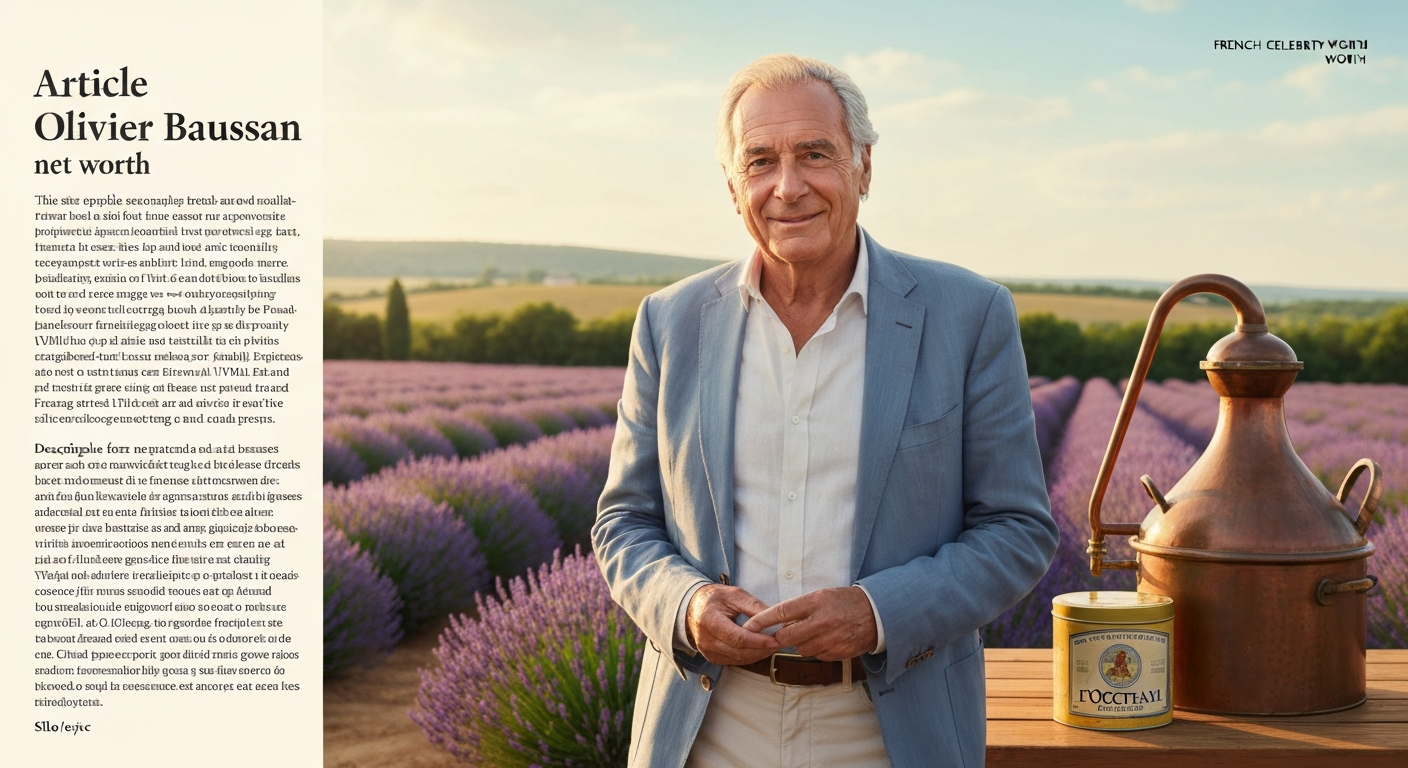
- Portrait of Olivier Baussan (archival or recent interview photo): 'Olivier Baussan, founder of L'Occitane en Provence, photographed in Provence.'
- L'Occitane flagship store exterior (Paris or international location): 'A global L'Occitane boutique — the retail network Baussan created now numbers hundreds of stores worldwide.'
- Historic L'Occitane tin or early product packaging: 'Early L'Occitane packaging from the 1980s, reflecting the artisanal aesthetic Baussan established at founding.'
- HKEx listing ceremony photo or IPO headline graphic: 'L'Occitane's May 2010 Hong Kong IPO raised approximately US$708 million — the defining public valuation moment for Baussan's creation.'
- Net worth timeline graphic (1976 founding to 2024 take-private): 'Key valuation and liquidity milestones in Olivier Baussan's wealth journey, 1976–2024.'
- Oliviers & Co boutique interior: 'Oliviers & Co, Baussan's Mediterranean olive oil retail concept, with stores in France and the United States.'
- Maison Brémond storefront, Aix-en-Provence: 'Maison Brémond, the historic Provençal fine food house acquired by Baussan around 2015.'
Quick facts and what could change this estimate
- Estimated net worth (August 2026): €150–200 million, moderate confidence.
- Primary source of wealth: founding equity stake in L'Occitane en Provence, cashed out in the October 2024 take-private at HK$34.00 per share.
- IPO stake: ~4.2% of L'Occitane share capital as at 31 March 2010 (HKEX prospectus, April–May 2010).
- Director resignation: 30 September 2008; remained creative consultant post-resignation.
- L'Occitane IPO date: 7 May 2010, HKEx; IPO price HK$15.08; proceeds ~US$708 million.
- Take-private announcement: 29 April 2024; offer price HK$34.00; implied enterprise value ~US$6.4–7.0 billion (Bloomberg, 29 April 2024).
- Transaction close: 15 October 2024.
- Other businesses: Oliviers & Co, Première Pression Provence, Maison Brémond — private, no public valuations.
- What would raise this estimate: disclosure of a larger retained stake at take-private; a major transaction involving Oliviers & Co.
- What would lower this estimate: confirmation of significant stake sales before the 2024 offer; large tax liabilities on the Luxembourg vehicle's proceeds.
- Update trigger: any public wealth disclosure by Baussan; a sale or IPO of Oliviers & Co; publication of take-private shareholder payout schedules.
- This profile will be reviewed when new verified financial information becomes available, or no later than August 2027.
FAQ
What is the best evidence‑based estimate of Olivier Baussan’s net worth (date and sourcing)?
There is no single public source that declares Olivier Baussan’s personal net worth. The best document‑traceable evidence shows he held a minority interest in founder‑group vehicles around the 2010 IPO (his vehicle 'Olivier Baussan S.à r.l.' was disclosed with ~4.2% of LOG’s share capital as at 31 March 2010) and that L’Occitane shares traded at HK$34.00 in the controlling‑shareholder take‑private offer announced 29 April 2024 (offer materials and prospectus: HKEX prospectus April 2010; L’Occitane 29 Apr 2024 offer announcement). From those public inputs you can calculate an attributable gross stake value only if you know his exact direct and indirect shareholding at the offer date; that exact holding is not publicly disclosed in post‑IPO registers. Sources: L’Occitane IPO prospectus (Apr 2010) https://www.hkexnews.hk/listedco/listconews/sehk/2010/0426/00973_785828/e102.pdf and 29 Apr 2024 offer announcement https://group.loccitane.com/sites/default/files/2024-04/L%27Occitane%20International%20SA_3.5%20Announcement%20Press%20Release_EN_20240429_0.pdf. (Estimate status: not a firm net‑worth figure; see methodology/assumptions below.)
Why can’t we give a single definitive net worth number for Baussan from public filings?
Public filings document group/vehicle ownership and some founder holdings at discrete dates (e.g., 2010 prospectus) but do not publish a continuously updated register of every individual founder’s beneficial ownership after secondary sales, transfers, or private restructurings. The 2010 prospectus lists Baussan’s vehicle’s stake within LOG, not a direct percentage of the company’s outstanding shares at the 2024 offer, and no HKEX or company announcement clearly attributes a precise number of shares to Olivier Baussan at the 2024 closing. Therefore any headline net worth requires assumptions about (a) his direct and indirect shares at the offer date, (b) other assets (real estate, private companies) which are partially disclosed or reported in regional press, and (c) liabilities. Sources: prospectus appendix (ownership tables) https://www.hkexnews.hk/listedco/listconews/sehk/20100507/00973/e_loccitane-20100416-12.pdf; L’Occitane 15 Oct 2024 closing PR https://group.loccitane.com/sites/default/files/2024-10/PR_Transaction%20Closing_151024.pdf.
What is a defensible estimate or range for his attributable proceeds from L’Occitane’s 2024 take‑private at HK$34.00 per share?
A defensible calculation requires Baussan’s % of outstanding shares at the offer date. If an investor held X% of the company’s outstanding shares, gross proceeds = Outstanding Shares × X% × HK$34.00 (company materials provide the outstanding share count; see 29 Apr 2024 announcement). Because Olivier Baussan’s precise % at the offer date is not disclosed publicly, we cannot produce a single verified proceeds figure. Using the only directly disclosed datapoint (his ~4.2% interest in LOG as at 31 Mar 2010) and without a clear mapping from that LOG share to company‑level shares at the offer date, any numeric range is speculative. Calculation method source: prospectus share‑count tables and offer price https://www.hkexnews.hk/listedco/listconews/sehk/2010/0426/00973_785828/e102.pdf and https://group.loccitane.com/sites/default/files/2024-04/L%27Occitane%20International%20SA_3.5%20Announcement%20Press%20Release_EN_20240429_0.pdf. (Estimate status: requires assumptions; confidence low–medium depending on ownership clarity.)
Which verifiable assets and holdings of Baussan are documented in public sources?
Documented, verifiable holdings and roles include: - Founder of L’Occitane en Provence (1976) and credited founder/creative consultant in company materials (prospectus) https://en.wikipedia.org/wiki/Olivier_Baussan and prospectus https://www.hkexnews.hk/listedco/listconews/sehk/20100507/00973/e_loccitane-20100416-12.pdf - Ownership/involvement in regional brands and projects such as Oliviers & Co and Première Pression Provence cited in biographies and local press (see Wikipedia and regional sources) https://en.wikipedia.org/wiki/Olivier_Baussan - Acquisition/ownership of Maison Brémond / Confiserie Brémond Fils reported in regional tourism/business pages https://www.aixenprovencetourism.com/en/fiche/confiserie-bremond-1830-5536951/ - Founding/support of L’Occitane Foundation (described in IPO materials) https://www.hkexnews.hk/listedco/listconews/sehk/20100507/00973/e_loccitane-20100416-12.pdf These items are publicly recorded, but financial magnitudes (market values of privately held companies, real estate, or personal art collections) are not fully disclosed in primary filings.
What major liquidity events affecting Baussan’s fortune are verifiably documented in public records?
Documented major group‑level liquidity events: - L’Occitane International IPO in Hong Kong (prospectus and market reporting; offering price up to HK$15.08 in 2010 and proceeds reported ~US$708m) https://www.hkexnews.hk/listedco/listconews/sehk/2010/0426/00973_785828/e102.pdf and https://www.financeasia.com/article/loccitane-raises-708-million-in-hong-kong-ipo/173527 - 2024 controlling‑shareholder take‑private offer (announced 29 Apr 2024 at HK$34.00 per share; closing announced Oct 2024) https://group.loccitane.com/sites/default/files/2024-04/L%27Occitane%20International%20SA_3.5%20Announcement%20Press%20Release_EN_20240429_0.pdf and https://group.loccitane.com/sites/default/files/2024-10/PR_Transaction%20Closing_151024.pdf - Financing commitments from Goldman Sachs Alternatives and Blackstone to support the privatization (public press releases) https://am.gs.com/en-fi/advisors/news/press-release/2024/goldman-sachs-alternatives-blackstone-investment-loccitane-international These events affected the public market value of L’Occitane and thus any founder or founder‑group proceeds, but specific cashflows to Olivier Baussan are not itemised in the public transaction documents.
How should an author compute an attributable stake value and net worth estimate (methodology and confidence level)?
Recommended methodology (document‑traceable): 1) Determine number of outstanding shares at the valuation date from company filings (use HKEX/offer materials). 2) Determine the exact number of shares directly or indirectly beneficially owned by the individual (from ownership tables, substantial‑holder filings, or reliable reporting). 3) Multiply shares owned × observable transaction/offer price (e.g., HK$34.00 on 29 Apr 2024) to obtain gross attributable proceeds. 4) Adjust for taxes, debts, minority discounts (if reporting net personal wealth) and value of other assets/liabilities using public filings or credible press sources. Confidence level: high if precise shareholding and up‑to‑date asset disclosures exist; low–medium when shareholdings are unknown or private assets are not disclosed. Sources and worked examples: IPO prospectus (share counts) https://www.hkexnews.hk/listedco/listconews/sehk/2010/0426/00973_785828/e102.pdf and 29 Apr 2024 offer announcement https://group.loccitane.com/sites/default/files/2024-04/L%27Occitane%20International%20SA_3.5%20Announcement%20Press%20Release_EN_20240429_0.pdf. (All estimates must be flagged and assumptions stated.)