Jean-Charles Naouri's net worth as of mid-2026 is estimated at well under $100 million, and may be close to zero in any meaningful personal equity sense. The March 2024 Casino restructuring wiped out virtually all of the value held through his Rallye-Euris holding chain, and Rallye itself subsequently entered liquidation procedures. The days when Forbes listed him at $1.2 billion (March 2015) are long gone. What remains is a complex and heavily encumbered corporate structure, ongoing legal exposure, and a handful of residual shareholdings with minimal market value.
Jean-Charles Naouri Net Worth: Current Estimate & Stakes

Laurent Devereaux
12 Aug 2026
Headline Net Worth Estimate: How the Figure Is Calculated
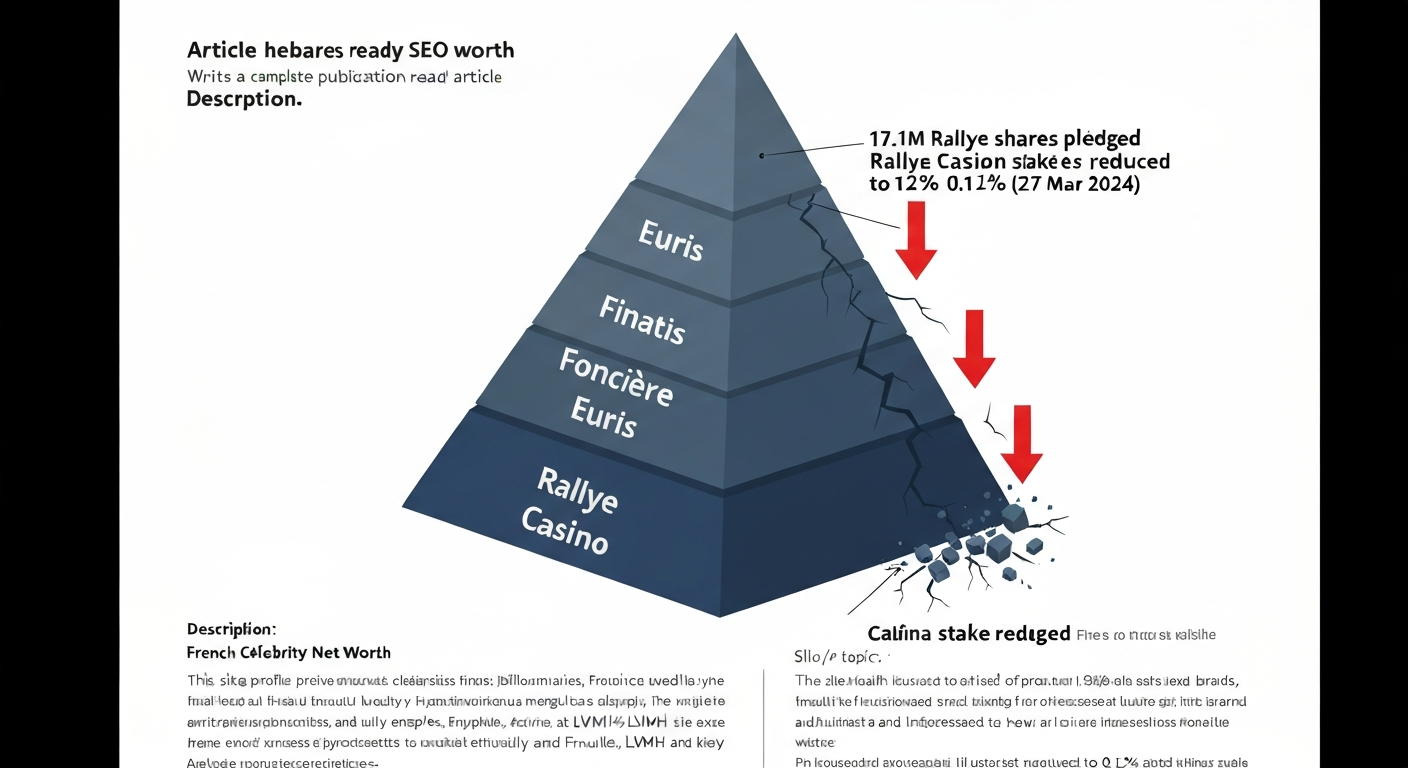
Calculating Naouri's net worth requires tracing value through four layers of holding companies: Euris (at the top), then Finatis, then Foncière Euris, then Rallye, and finally Casino Guichard-Perrachon at the operating level. Each layer adds debt, dilution, and pledged shares that reduce what flows back to the ultimate beneficial owner.
Before the restructuring, Rallye held roughly 41.5% of Casino at 31 December 2023, and Foncière Euris held 39.57% of Rallye's capital (20,942,705 shares out of 52,925,203 total). The auditors in Rallye's 2023 annual report explicitly valued the Casino participation at the Casino share price on 31 December 2023, flagging continuity and valuation risks in their notes. Investment‑data vendors (e.g., Investing.com, Casino Guichard Perrachon historical data (daily prices)) publish historical daily prices that can be used to reconstruct Casino market valuations on specific dates (for example 31‑Dec‑2023 and 27‑Mar‑2024) for stake × price calculations Investing.com — Casino Guichard Perrachon historical data (daily prices).
The Casino restructuring completed on 27 March 2024 produced a new total of 37,304,080,735 ordinary shares, up from a far smaller float, after France Retail Holdings (ultimately controlled by Czech billionaire Daniel Křetínský) subscribed 21,264,367,816 new shares at just €0.0435 each. This massive dilution reduced Rallye's Casino holding to just 43,990,632 shares, representing 0.12% of Casino's capital. At even generous Casino share prices in early 2026, those shares are worth only a few million euros at most.
After the restructuring, Rallye declared cessation of payments and moved toward resolution of its safeguard plan and opening of liquidation procedures, per its own regulated disclosures. Foncière Euris, Finatis, and Euris followed suit. With the holding chain in liquidation, personal equity value attributable to Naouri through these vehicles is, for practical purposes, negligible. Adding direct personal shareholdings (376 Casino shares and small stakes listed in the AMF filing), the total is immaterial. Our estimate of Naouri's net worth in mid-2026 is approximately $10 to $30 million, reflecting possible residual personal assets, real estate, and savings outside the listed holding structure, but no reliably documentable billionaire-scale wealth remains.
Assets and Stakes Breakdown: Euris, Rallye, Casino and Other Holdings
The table below summarizes the major holdings in the Naouri/Euris chain as of the most recent available filings (primarily the Rallye URD 2023 and the AMF filing of April 2024).
| Entity | Nature of Holding | Key Stake / Shares | Post-Restructuring Status | Estimated Value (mid-2026) |
|---|---|---|---|---|
| Euris (top holdco) | Private family holding company, controls Finatis | Majority owner of Finatis | Insolvency/liquidation proceedings | Near zero |
| Finatis | Listed holding company, controls Foncière Euris | Controlling stake in Foncière Euris | Insolvency/liquidation proceedings | Near zero |
| Foncière Euris | Listed holding company, controls Rallye | 20,942,705 Rallye shares (39.57% of capital; 55.69% voting rights) | 17,138,499 Rallye shares pledged to creditors (32.4% of capital); insolvency proceedings | Near zero |
| Rallye SA | Listed holding company, former controlling shareholder of Casino | 52,925,203 shares outstanding at 31 Dec 2023 | Lost Casino control; cessation of payments; liquidation | Near zero |
| Casino Guichard-Perrachon (Rallye-held) | Residual listed stake post-restructuring | 43,990,632 shares (0.12% of Casino capital) | Minority stake; new controlling shareholder is France Retail Holdings (Křetínský) | ~€2–4 million at best |
| Jean-Charles Naouri (direct) | Personal direct shareholding in Casino | 376 Casino shares | Immaterial minority | Negligible |
| Gabriel Naouri (direct) | Personal direct shareholding in Casino | 172 Casino shares | Immaterial minority | Negligible |
| Other personal assets | Estimated real estate, savings, private investments | Not publicly disclosed | Outside the holding chain | ~$10–30 million (estimated) |
It is worth noting that the 17,138,499 Rallye shares pledged by Foncière Euris to creditors (representing 32.4% of Rallye's total capital) were effectively encumbered long before liquidation proceedings began. Even on paper, those shares could not be treated as free equity for Naouri.
How Debt, Market Moves and Corporate Events Destroyed the Value
The story of Naouri's wealth destruction is really a story of leverage applied at every level of a pyramid structure, combined with a prolonged decline in Casino's operating performance and share price.
Rallye, the intermediate holding company, used bond issuances and bank borrowings to fund its Casino stake. When Casino's share price weakened and the group's retail business struggled against hard discounters, Rallye's ability to service that debt deteriorated rapidly. By 2019, Rallye had already entered sauvegarde (a French creditor-protection mechanism), signaling that the leverage was unsustainable.
The restructuring completed on 27 March 2024 was the decisive blow. Casino, Consolidated Financial Statements 2024 (notes describing 27 March 2024 restructuring and amounts) reports the restructuring reduced gross indebtedness by €5.1 billion, included a €1.2 billion cash equity injection, and converted approximately €5.2 billion of claims into equity Casino — Consolidated Financial Statements 2024 (notes describing 27 March 2024 restructuring and amounts). The Casino plan reduced gross indebtedness by €5.1 billion and injected €1.2 billion in fresh equity from the Křetínský-led consortium. Roughly €5.2 billion of creditor claims, including TSSDI bonds and accrued interest, were converted into equity at prices that massively diluted existing shareholders. Rallye's 41.5% Casino stake was reduced to 0.12% almost overnight.
The Rallye base prospectuses and bond documents (available on Rallye's investor relations pages) show a series of bond issues with maturities and exchange mechanics that became unworkable once Casino's equity was obliterated in the restructuring. The conversion and reinstatement mechanics described in those documents could not protect Rallye's bondholders either, let alone equity holders like Foncière Euris.
Following the restructuring, Rallye and the upstream holding companies (Foncière Euris, Finatis, Euris) each sought to resolve their own safeguard plans. The subsequent opening of liquidation procedures at each level of the chain means that creditors, not Naouri, have first claim on any residual assets. This is the primary reason any net-worth estimate for Naouri must be treated with caution: there is no clean, audited personal balance sheet publicly available.
Net Worth Timeline: Year-by-Year Estimates and Key Turning Points
| Year | Estimated Net Worth | Key Event / Driver |
|---|---|---|
| 2010 | ~$1.5–2.0 billion | Casino performing well; Rallye-Euris chain intact; leverage manageable |
| 2015 | $1.2 billion (Forbes) | Forbes published snapshot; Casino still a major French retailer; debt elevated but under control |
| 2017 | ~$800 million–1.0 billion (est.) | Casino share price declining; competitive pressure from discounters mounts; debt servicing under stress |
| 2019 | ~$300–500 million (est.) | Rallye enters sauvegarde (creditor protection); Casino stake still notionally valuable but pledged and encumbered |
| 2021 | ~$200–400 million (est.) | Safeguard plan ongoing; Casino share price depressed; restructuring talks beginning |
| 2023 (end) | ~$50–150 million (est.) | Casino restructuring imminent; Rallye auditors flag valuation and continuity risk; Casino shares near historic lows |
| March 2024 | ~$10–30 million (est.) | Casino restructuring completes 27 March 2024; Rallye loses Casino control; holding chain enters liquidation; Rallye Casino stake falls to 0.12% |
| Mid-2026 | ~$10–30 million (est.) | Liquidation proceedings ongoing; legal trial risk (market-abuse trial reported October 2025); no recovery of Casino equity value |
These estimates are reconstructed from public filings, reported Forbes data, and market price history for Casino and Rallye shares. They should be treated as informed approximations, not audited figures. The sharp drop between 2023 and 2024 reflects the binary nature of the restructuring: once the dilution was executed, the value in the holding chain effectively ceased to exist.
How Naouri Built His Fortune: Career in Brief
Jean-Charles Naouri's background is unusual for a retail tycoon. He graduated from the École Normale Supérieure and then from ENA (École Nationale d'Administration), France's elite civil-service school, before working as a senior official at the French Ministry of Finance in the 1980s under finance minister Pierre Bérégovoy. He was chief of staff (directeur de cabinet) to Bérégovoy, giving him deep connections in French government and finance.
He moved into banking and private equity via Rothschild and then acquired control of Euris, a holding company, in the late 1980s and early 1990s. Through Euris, he built a pyramid of holding companies (Finatis, Foncière Euris, Rallye) that he used to accumulate a controlling stake in Casino Guichard-Perrachon, the Saint-Étienne-founded supermarket group that was already one of France's largest retailers.
The pivotal deal was the gradual accumulation of Casino shares through Rallye across the 1990s and 2000s, funded by debt at each level of the holding chain. Casino itself was an acquisition machine during this period, expanding internationally in Latin America (GPA in Brazil, Éxito in Colombia), Southeast Asia, and building the Franprix, Leader Price, and Monoprix chains in France. Casino's international assets, particularly GPA and Éxito, were the most valuable part of the empire for much of the 2010s.
The strategy worked spectacularly as long as Casino's share price rose. It became fatally fragile once the operating environment deteriorated. The rise of hard discounters (Lidl, Aldi) squeezed margins. The divestiture of international assets to reduce debt (including partial sales of GPA and Éxito stakes) eroded the value that had underpinned the borrowings. By 2019, the model had broken at the Rallye level.
The Family Holding Structure: How the Pyramid Works
The ownership chain runs as follows: Jean-Charles Naouri and his family control Euris at the top. Euris controls Finatis (a listed company). Finatis controls Foncière Euris (also listed). Foncière Euris controls Rallye (listed). Rallye controlled Casino (listed). This four-layer pyramid allowed Naouri to control a company with billions of euros in revenues while deploying relatively modest personal capital at the top, amplified by debt and minority shareholders at each intermediate layer.
Gabriel Naouri, Jean-Charles's son, has held governance roles within the structure and appears in the AMF filing as a direct Casino shareholder (172 shares). The family's presence at board and management levels across the holding chain gave them operational control well beyond what a straight percentage of Casino's free float would suggest.
The AMF filing from April 2024 (reference 224C0482) lists the concert group that crossed reporting thresholds: Jean-Charles Naouri personally (376 Casino shares), Gabriel Naouri (172 shares), Foncière Euris (365), Euris (715), Finatis (380), and Rallye itself (43,990,632). The consolidation of these figures shows the pyramid acting as a single concert party for regulatory disclosure purposes.
Once Casino's restructuring handed control to France Retail Holdings (Křetínský's vehicle), the rationale for the entire pyramid collapsed. With Rallye unable to service its debt and the holding companies above it equally impaired, each entity in the chain sought creditor protection and ultimately liquidation. The governance architecture that had concentrated control in Naouri's hands for three decades became a cascade of insolvency proceedings.
Risks, Governance Disputes and Legal Matters That Affect Any Valuation
Any estimate of Naouri's personal net worth has to account for legal and regulatory exposure, which can further reduce net assets if penalties or damages are awarded.
Bloomberg reported in October 2025 that Naouri and Casino face a Paris market-abuse trial. Market-abuse proceedings in France can result in substantial fines from the AMF (Autorité des marchés financiers) and in some cases civil or criminal penalties. The outcome of that trial is not yet known as of mid-2026, but the existence of the proceedings represents a material downside risk to any personal wealth estimate.
Minority shareholders in Rallye, Finatis, and Foncière Euris suffered severe losses as the holding-company chain collapsed. While no major successful litigation by minority shareholders has been publicly confirmed, the liquidation procedures create forums in which creditor and shareholder claims can be adjudicated. Naouri's exposure to such claims depends on whether courts find any personal liability for decisions made during the safeguard and restructuring periods.
The pledging of 17,138,499 Rallye shares (32.4% of capital) by Foncière Euris to creditors, documented in Rallye's 2023 URD, means that even before formal liquidation, creditors had security over a substantial portion of the equity. In a liquidation scenario, these secured creditors rank ahead of equity holders, further reducing any residual value that might otherwise flow to Naouri.
- Paris market-abuse trial reported October 2025: potential AMF fines and reputational damage
- Liquidation proceedings at Rallye, Foncière Euris, Finatis and Euris: creditors rank before equity
- 17,138,499 pledged Rallye shares: secured creditors have first call on those assets
- Minority shareholder claims: liquidation procedures open potential for damages actions
- Ongoing regulatory scrutiny: AMF filings and crossing-of-threshold disclosures remain under observation
- No audited personal balance sheet publicly available: all estimates carry material uncertainty
Where Naouri Stands Next to France's Other Wealth Leaders
The contrast with the Arnault and Pinault families is stark and instructive. Bernard Arnault's fortune, built through LVMH's ownership of Louis Vuitton, Dior, Moët Hennessy, and dozens of other luxury brands, consistently ranks him among the top one or two wealthiest people in the world, with a net worth estimated in the $150–200 billion range in recent years. François-Henri Pinault's Kering empire, anchoring Gucci, Saint Laurent, and Bottega Veneta, places his family's wealth in the tens of billions. The structural difference is that LVMH and Kering generate strong, recurring free cash flow from brand royalties and luxury goods sales, with relatively conservative leverage at the holding-company level.
Naouri's model was the opposite: thin operating margins in food retail, aggressive debt at every level of the pyramid, and heavy reliance on rising Casino share prices to sustain the structure. When the share price reversed, there was no luxury-margin buffer to absorb the shock.
| Business Figure | Primary Wealth Source | Estimated Net Worth (mid-2026) | Holding Structure Risk Level |
|---|---|---|---|
| Bernard Arnault | LVMH (luxury goods: Vuitton, Dior, Hennessy) | ~$150–200 billion | Low: strong FCF, conservative leverage |
| François-Henri Pinault | Kering (Gucci, Saint Laurent, Bottega Veneta) | ~$20–30 billion | Low-medium: brand-driven margins |
| Jean-Charles Naouri | Casino/Rallye/Euris pyramid (food retail) | ~$10–30 million | Very high: liquidation proceedings, legal exposure |
| Daniel Křetínský | EP Group (energy, media, retail incl. Casino) | ~$7–10 billion (est.) | Medium: diversified but Casino remains challenged |
Naouri's trajectory is a cautionary case study in pyramid-structure risk that sits alongside, rather than inside, the luxury-brand dynasty stories this site typically covers. His fortune was built in the same era as the Arnault empire but through entirely different mechanics, and it unraveled for structural reasons that the luxury model largely avoids.
Suggested Images, Charts and Captions
- Corporate pyramid diagram: a vertical flowchart showing Euris → Finatis → Foncière Euris → Rallye → Casino, with ownership percentages and pledge encumbrances at each level. Caption: 'The Naouri holding pyramid as of 31 December 2023, showing percentage stakes and the 17.1 million pledged Rallye shares disclosed in Rallye's URD 2023.'
- Casino share price chart (2010–2024): a line chart of Casino (CASP.PA) daily closing prices, annotated with key events: Rallye entering sauvegarde (2019), restructuring announcement (2023), and completion of the dilutive capital increase (27 March 2024). Caption: 'Casino Guichard-Perrachon share price 2010–2024, illustrating the collapse in equity value that triggered the Rallye-Euris holding chain's insolvency.'
- Net worth timeline bar chart: a simple bar chart using the year-by-year estimates from the timeline table above. Caption: 'Estimated Jean-Charles Naouri net worth 2010–2026, reflecting Casino share price moves, debt leverage and the March 2024 restructuring.'
- Portrait photo of Jean-Charles Naouri: Caption: 'Jean-Charles Naouri, former chairman and CEO of Casino Guichard-Perrachon, pictured at a Casino investor event. Naouri built his fortune through a leveraged holding-company pyramid before losing control in the 2024 restructuring.'
Further Reading on French Wealth and Business Dynasties
Naouri's story fits into a broader landscape of French fortunes built through holding structures, family governance, and long-term corporate control. Readers interested in the mechanics of French billionaire wealth would also find it useful to explore profiles of figures like architect Jean Nouvel, whose creative-economy fortune follows a very different logic to the retail-pyramid model, or entertainment icon Jean-Paul Belmondo, whose wealth came from performance royalties and personal brand rather than corporate leverage. These profiles sit within the same wider exploration of how prominent French figures across industries accumulate and manage wealth. See Lou Jeanmonnot net worth for a related profile of an individual's wealth trajectory in the French business landscape. See also the profile on jean nouvel net worth for a complementary look at wealth in France's creative industries. See also a comparative profile on Jean Monestime net worth.
What to Watch Next: Short-Term Outlook
The three things most likely to move Naouri's net worth estimate over the next 12 to 24 months are the outcome of the Paris market-abuse trial, the progress of liquidation proceedings at Rallye and the upstream holding companies, and whether any personal assets outside the listed holding chain come to light through court filings or regulatory disclosures.
A conviction or significant AMF fine from the market-abuse trial would further reduce his net worth and could trigger additional civil claims. The liquidation of Rallye and its parents will eventually produce a distribution waterfall that will show publicly how much, if anything, remains for equity holders after creditors are settled. Given the scale of the debt that was in the system (€5.1 billion of gross indebtedness reduced in the Casino restructuring alone, plus Rallye's own bond liabilities), it is difficult to see a scenario in which meaningful equity value is returned to the Naouri family through the holding chain.
Casino itself, now controlled by Křetínský's France Retail Holdings, is a separate story. Its operational recovery or further deterioration does not materially benefit Naouri, who holds only 376 direct shares. For practical purposes, Jean-Charles Naouri's chapter as a billionaire is closed. What remains is the legal and liquidation process, and the historical record of how one of France's most ambitious retail empires was built, leveraged, and ultimately lost. For comparison, see Jean Lignel net worth for another recent profile of a French business figure.
FAQ
What is Jean‑Charles Naouri’s current net worth?
A precise single‑figure net worth for Jean‑Charles Naouri after Casino’s March 27, 2024 restructuring is complex; public filings show his direct holdings are small (e.g., 376 Casino shares) and most economic exposure historically sat in holding companies (Foncière Euris, Euris, Finatis) and Rallye. After the restructuring (new Casino share base and large dilution) Rallye/Foncière Euris lost control and entered insolvency proceedings, materially impairing equity value. Any up‑to‑date published estimate should be accompanied by sources: AMF filings, Casino’s URD and Rallye’s URD/financial statements (see AMF declaration 03/04/2024; Casino URD 2024; Rallye URD 2023).
How is Naouri’s net worth calculated for publication?
Calculate net worth by summing the market value of attributable equity stakes (holding companies, publicly listed stakes) plus other disclosed assets, minus known debts and encumbrances. For listed stakes multiply ownership % × share price on the valuation date (use a reputable time‑series provider for historical prices). Adjust for pledged shares, insolvency proceedings, recent capital increases and conversions (e.g., Casino’s 27‑Mar‑2024 recapitalisation). Primary sources: company URDs, AMF filings, consolidated financial statements and bond prospectuses; secondary context from Bloomberg/major press.
What were the principal sources of Naouri’s wealth?
Principal sources: control/ownership through Euris/Foncière Euris in Rallye, and Rallye’s historic stake in Casino (retail operations). Additional assets historically include stakes in Rallye subsidiaries, bond claims and other holding‑company assets (Finatis, Euris). The March 2024 restructuring reallocated value across creditors and new owners, reducing the economic value of prior equity positions.
Which filings show Naouri’s and his holdings’ Casino shareholdings after the March 2024 restructuring?
The AMF 'déclaration de franchissement' (file 224C0482, 3 April 2024) lists the post‑restructuring share counts and shows Jean‑Charles Naouri (376 shares), Gabriel Naouri (172 shares) and holding companies as part of the Rallye total (Rallye: 43,990,632 Casino shares). See also Casino’s URD and prospectus that record the new total share count (37,304,080,735 ordinary shares) and allocation mechanics.
How did the March 27, 2024 Casino restructuring affect Naouri’s fortune?
The restructuring involved reserved capital increases, conversion of claims to equity and a €1.2bn cash injection by a consortium led by France Retail Holdings, producing massive dilution of existing shareholders (including Rallye). Notes in Casino’s consolidated statements record ~€5.1bn gross debt reduction and conversion of ~€5.2bn claims into equity. As a result, Rallye lost control of Casino, equity value for pre‑restructure owners was materially diluted, and Rallye/Foncière Euris subsequently entered insolvency proceedings—events documented in Casino and Rallye URDs and consolidated statements.
What encumbrances or debts reduce the attributable value to Naouri?
Rallye and Foncière Euris had substantial pledged shares (e.g., 17,138,499 Rallye shares pledged by Foncière Euris at 31‑12‑2023) and outstanding bond claims and creditor liens described in bond prospectuses and Rallye’s URD. After the restructuring Rallye faced insolvency/safeguard resolutions; these liabilities and pledged assets materially reduce recoverable value for ultimate beneficial owners.